
If I were looking for an adjective for the past week, the word “conversation” would certainly come to mind, although there is some doubt as to whether this noun can serve as an adjective now. What is certain, however, is that there was no shortage of meaningful conversations over the past week. During the Advocacy Forum held mid-week, a long and serious discussion developed about how much community programs can be labeled as “mandatory”; what should we do with those who are not really “community people,” who are rather withdrawn? Where is the limit of tolerance and understanding, at what point do we feel that community building and group dynamics might be compromised, and what happens after a while to those who feel they are always doing the heavy lifting? Important thoughts were voiced regarding the quality and quantity of family visits, and how important and even necessary they remain as time goes on. We easily reached a consensus: yes, maintaining contact is essential across all age groups.
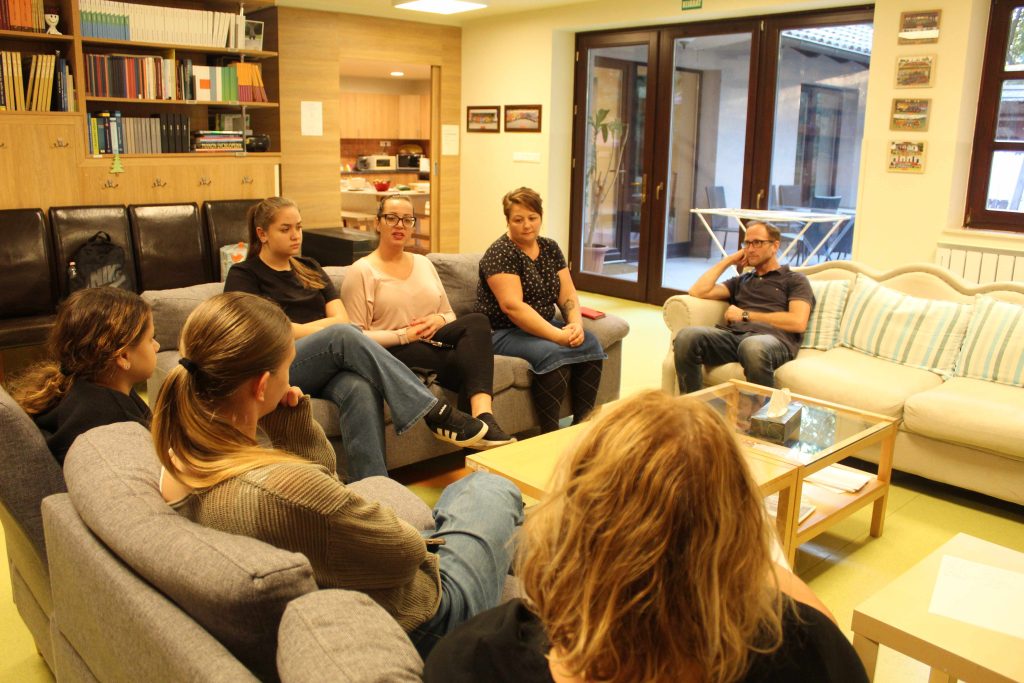
In a similar fashion, digging deeper beneath the surface rather than just scratching it, the youth of Kaposvár Group 2 participated in an event held on October 10 as part of our sub-project titled “Conversations with an Old Man.” Our guest speaker this time was Dr. Adél Endrődi, a lawyer. Two members of the group shared their thoughts based on their experience:
In the second act of the discourse series – organized this time by our mentor – truth was on the table, and to dissect the topic, our guest was a lawyer. Although I strongly believe that engaging in dialogue on practically any topic is important, this concept and its exploration still hold a prominent place in line. Truth is a term that comes up very often and easily, one of those concepts we don’t really try to define because it seems obvious to everyone at first glance. Well, if we think about it more deeply, we quickly realize that this is not the case. Even if we examine its everyday meaning as a noun formed from the adjective true, contradictions arise at a million points. How do we decide if something is true? Is that which exists true? And is that which does not false? Are jeans, a toothpick, or a gold bar true, and God is not? How do we know what exists and what does not? Must we see, hear, feel, or touch whatever exists? For I have seen a dog and a person walking it, but I have hardly ever seen a mammal. So does a mammal not exist, meaning this word and concept are false? Or perhaps truth is that which means the same thing to everyone, is the same for everyone? If everyone likes chocolate and no one likes broccoli, is chocolate right? Or is truth that which is moral and ethical? And accordingly, is whatever is not true immoral? If I hide Jewish people in my cellar, and an SS officer knocks on the door, and I falsely tell him that there are certainly no Jewish people in my house, am I right and thus moral, or did I lie, fail to tell the truth, and therefore act immorally—or did I simply tell an untruth and thereby do good? There is no single “true” answer to any of these questions, but that does not mean there isn’t one at all. Truth exists, though not in just one form. There are as many truths as there are people and thoughts, perhaps even more. That is why I consider it right to introduce a new concept, namely reality. Reality can be defined quite well: everything is real that we can perceive with any of our senses, measure with some instrument, and which under the same conditions anywhere in the world is exactly the same as anywhere else. In this way, a stone, water, a coat, and the Bible are all real. But a heavy stone, pure water, a beautiful coat, and the Holy Bible remain mere truths. Still, even though reality came first and will endure, it is in searching for truths that we color existence into something that makes life worth living.
Dominik Antal
Even during the warm-up drama games, it became apparent how wide a spectrum our opinions cover – in some cases even depending on gender or age. Deep exchanges of thought developed on controversial topics such as whether capital punishment is justified, whether objective truth exists at all, whether the opinion of the majority is always true, or if someone believes in their own truth, are they truly right? Questions also surfaced that we face every day yet rarely look beneath the surface of: what is the difference between tact and lying, do we really have the right to always speak the truth, can a lie be validated for moral reasons? We have all reached crossroads in the ethical maze of our lives, searching for the right path, – and even the greatest philosophical minds among us get lost in whether an objectively correct decision even exists. Ultimately, I think that such conversations move all of us forward as human beings. In addressing serious moral and philosophical questions, we can plant small seeds in each other’s minds that over time may even reshape our entire worldview. Personally, I have also begun to re-examine my views on certain topics as a result of a thought expressed here or there. After all, what if my truth does not reflect reality…? Looking forward to the next occasion!
Jázmin Pretz